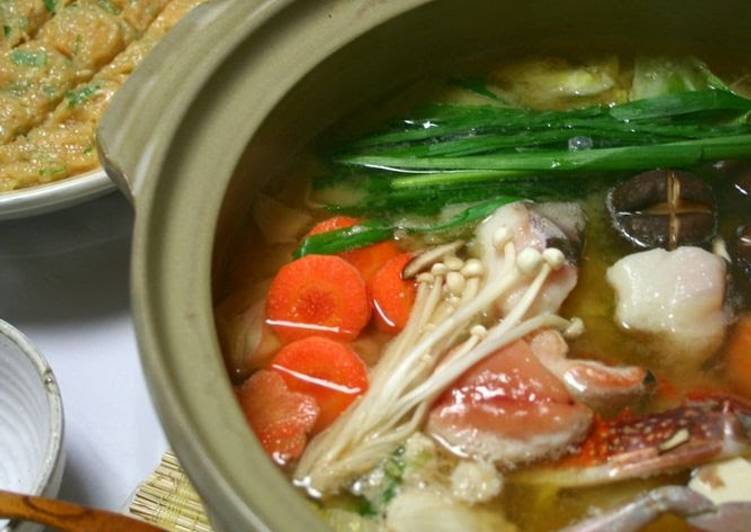
Hey everyone, hope you’re having an incredible day today. Today, we’re going to make a special dish, miso-flavored chanko nabe (hot pot). It is one of my favorites food recipes. This time, I am going to make it a bit unique. This will be really delicious.
I've cooked this healthy oyster hot pot made with organic miso, and cleaner ingredients. Normally, water is added on this but I didn't. Chanko Nabe or Sumo Stew is a robust hot pot filled with all kinds of vegetables and tons of protein in a rich dashi and chicken broth. This well-balanced meal is traditionally eaten by sumo wrestlers but also enjoyed at home or some restaurants.
Miso-flavored Chanko Nabe (Hot Pot) is one of the most favored of current trending meals on earth. It is easy, it’s fast, it tastes delicious. It is enjoyed by millions every day. They’re fine and they look wonderful. Miso-flavored Chanko Nabe (Hot Pot) is something which I have loved my whole life.
To begin with this particular recipe, we must prepare a few components. You can have miso-flavored chanko nabe (hot pot) using 21 ingredients and 5 steps. Here is how you can achieve it.
The ingredients needed to make Miso-flavored Chanko Nabe (Hot Pot):
- Make ready [Miso broth]
- Make ready 1600 ml Dashi stock (kombu, bonito base)
- Take 1 clove/ piece each Garlic, ginger
- Take 1 cube 〇 Soup stock
- Take 50 ml 〇 Sake
- Prepare 6 tbsp 〇 Miso
- Take 50 ml 〇 Mirin
- Take 1 dash 〇 Salt
- Take [Tsukune]
- Make ready 300 grams Ground chicken
- Make ready 1 clove/ piece Garlic, Ginger (grated)
- Prepare 3 tbsp Japanese leeks (finely chopped)
- Prepare 1 small Egg
- Make ready 1 tbsp Katakuriko
- Make ready 1 tbsp Miso
- Take 1 Sesame oil
- Make ready [Ingredients for the hot pot]
- Get 1 Salmon, cod, shrimp, crab
- Prepare 1 Cabbage, carrots, chives
- Get 1 Shimeji mushrooms, shiitake mushrooms, enoki mushrooms
- Make ready 1 Tofu
Great recipe for Miso-flavored Chanko Nabe (Hot Pot). This is my family's chanko nabe (hot pot) recipe. A lot of vegetables and meat can be cooked in seasoned broth at the same time at It is an easy and great hot dish in winter time. Chanko Nabe is a well known food for Sumo wrestlers in Japan.
Steps to make Miso-flavored Chanko Nabe (Hot Pot):
- [Prep the vegetables and fish] Cut the fish, vegetables, and tofu into bite-sized pieces. Crush the garlic and thinly slice the ginger. Make a cut in the center of the cabbage as shown in the photo and then cut into pieces of equal size.
- [Make the tsukune] Finely chop the Japanese leek and combine with all the ingredients for the tsukune. Knead well until the mixture becomes sticky.
- Add water and kombu to the pot and heat. When it starts to simmer and the kombu floats to the top, remove the kombu and add a dashi stock bag filled with bonito flakes, garlic and ginger. Bring to a boil again and simmer for 2 -3 minutes over low heat. Squeeze the liquid out of the dashi stock bag and remove. Add the 〇 seasonings.
- Lay the core pieces of cabbage in the bottom of the pot.
- Bring to a boil and add the fish and vegetables. When cooked through, it's done. Enjoy! The tsukune mixture can be dropped into the pot with a spoon while the broth is boiling.
A lot of vegetables and meat can be cooked in seasoned broth at the same time at It is an easy and great hot dish in winter time. Chanko Nabe is a well known food for Sumo wrestlers in Japan. If Japanese people are asked what Sumo. Chanko nabe is a type of Japanese hot pot eaten by sumo wrestlers. It features plenty of protein with chicken, fish, and tofu along with lots of Named after the Ishikari River in Hokkaido where salmon go to lay their eggs, this nabe features salmon as the main ingredient, and miso as the broth flavoring.
So that is going to wrap it up for this special food miso-flavored chanko nabe (hot pot) recipe. Thank you very much for your time. I’m confident that you can make this at home. There’s gonna be interesting food in home recipes coming up. Don’t forget to bookmark this page in your browser, and share it to your loved ones, friends and colleague. Thanks again for reading. Go on get cooking!